Choosing the Best Meditations Translation
As an Amazon Associate, we earn from qualifying purchases.
Meditations is a series of personal writings by Marcus Aurelius, Roman Emperor, reflecting on Stoic philosophy and how to live a virtuous life. It is a collection of spiritual exercises and personal reflections, emphasizing self-improvement, duty, and the transience of life.
Readers wanting a free option first can turn to this site’s own annotated edition, which uses the public-domain Haines 1916 translation, with the original scholarly footnotes plus new notes for anything a modern reader would find opaque. The comparison is for readers deciding whether to also acquire a modern edition.
Translation Comparison at a Glance
| Translation | Readability | Accuracy | Tone | Best For |
|---|---|---|---|---|
| Hays (2002) | Very high | Very good | Direct, unornamented, conversational | First-time readers, daily use |
| Hammond (2006) | High | Very good | Clear, measured, lightly formal | Readers who also want a full reference apparatus |
| Haines (1916), annotated | Moderate | Good | Formal, older English (“thou,” “hath”) | A free, fully annotated text |
| Waterfield (2021) | Moderate | Excellent | Literal, philosophical, scholarly | Serious study, Stoic context |
| Long (1862) | Moderate | Good | Victorian, formal, weighty | Historical comparison, free editions |
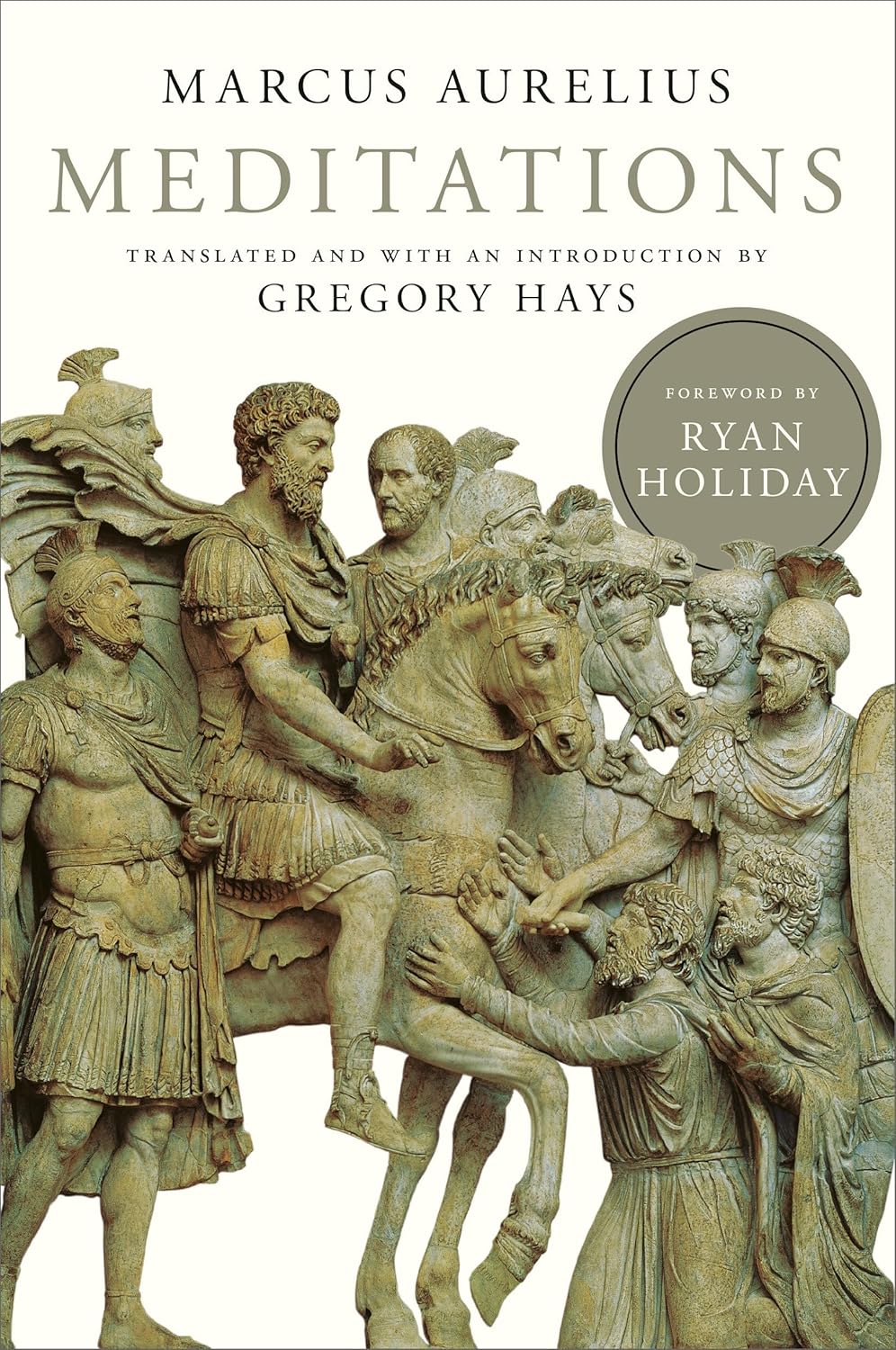
#1 — Meditations — trans. Gregory Hays (2002)
- Readability: Direct, unornamented modern prose that feels like a private journal.
- Accuracy: Very good; prioritizes accessibility while preserving philosophical precision.
- Tone: Conversational and urgent, as if Marcus is speaking to himself.
- Accessibility: Excellent entry point for readers without classical training.
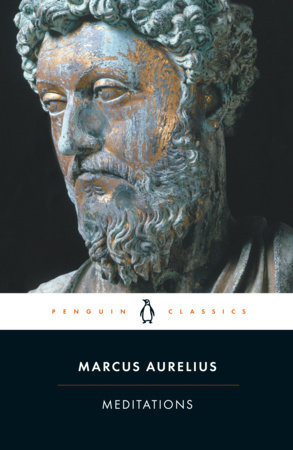
#2 — Meditations — trans. Martin Hammond (2006)
- Readability: Clear, measured modern prose — less colloquial than Hays, less literal than Waterfield.
- Accuracy: Very good; Hammond also translated Homer’s Iliad for Penguin Classics.
- Tone: Even and lightly formal, without Long’s Victorian weight.
- Accessibility: Comes with explanatory notes plus a general index, an index of quotations, and an index of names.
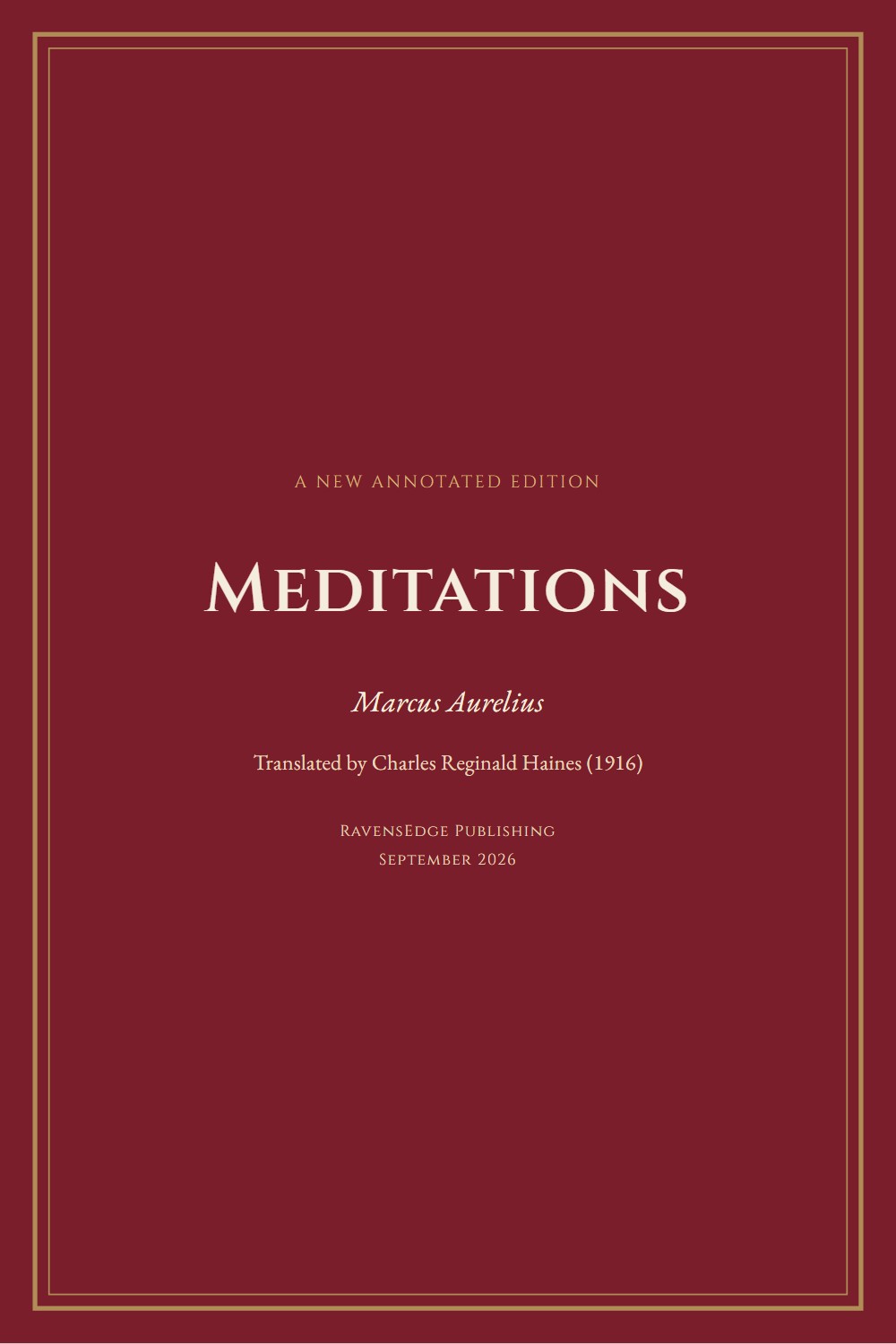
#3 — Meditations — trans. C. R. Haines (1916), Annotated Edition
- Readability: Formal, older English (“thou,” “hath”), closer to Long than to Hays.
- Accuracy: A classical scholar’s translation made for the Loeb Classical Library, with the Greek text printed alongside.
- Tone: Measured and formal.
- Accessibility: Free; a bookmarked PDF for reading on screen or tablet, also readable online.
Matching a Translation to the Reader
- Hays is best suited to a first encounter with Marcus, offering the most readable modern version, with a tone closer to a private journal.
- Hammond offers that same readability with real scholarly support built in — explanatory notes and three separate indices.
- Waterfield is best suited to readers already familiar with Hays who want a more literal, scholarly translation with extensive notes on Stoic philosophy.
- The annotated Haines edition is the free choice with notes: a free PDF, or read online.
- Long suits readers seeking another public-domain translation or a historical point of comparison.
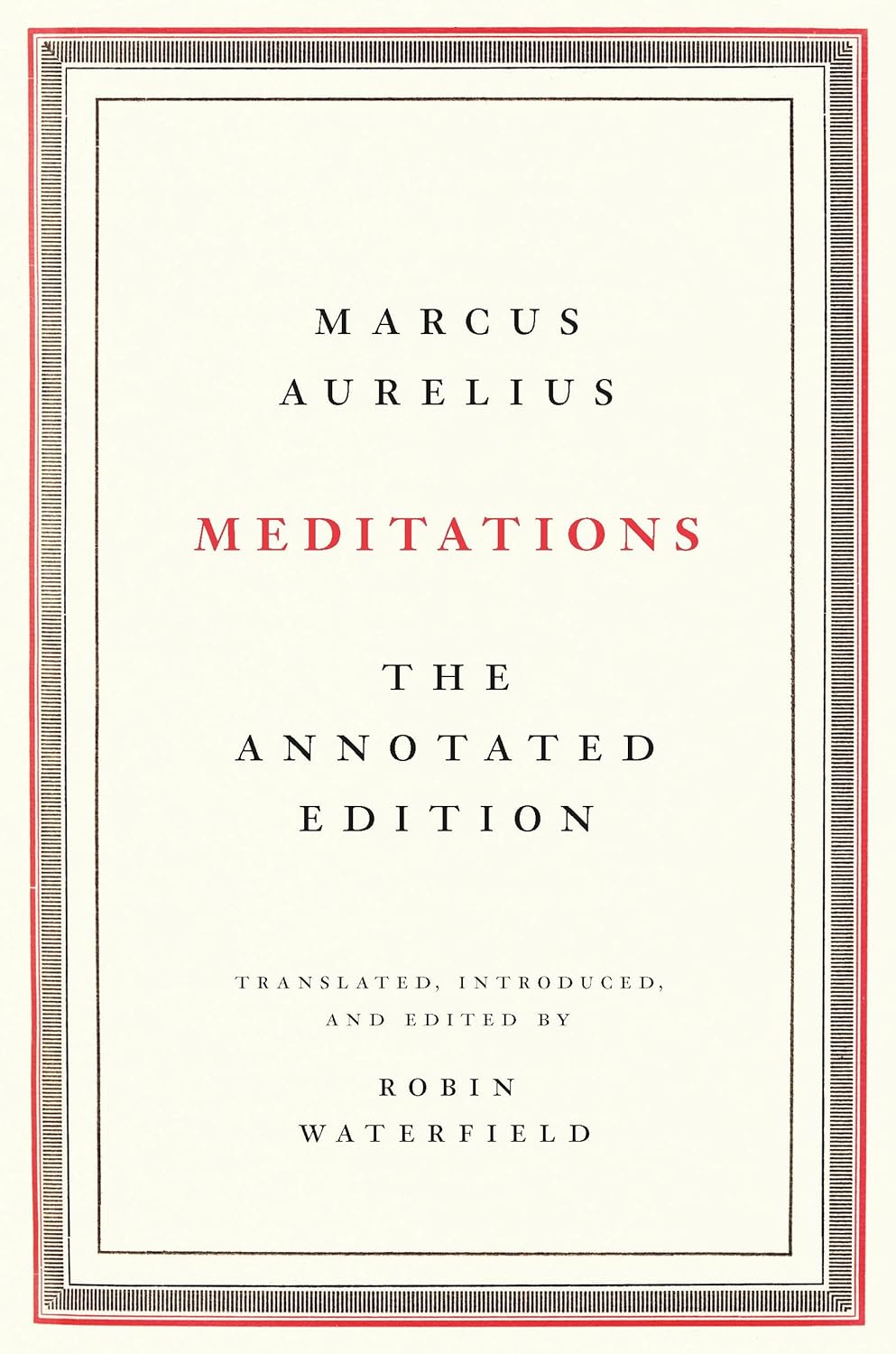
#4 — Meditations — trans. Robin Waterfield (2021)
- Readability: More literal and demanding than Hays; rewards careful reading.
- Accuracy: Excellent; most attentive to Stoic technical vocabulary and Greek text.
- Tone: Philosophical and rigorous, with substantial scholarly notes.
- Accessibility: Best after an initial reading; ideal for deeper study.
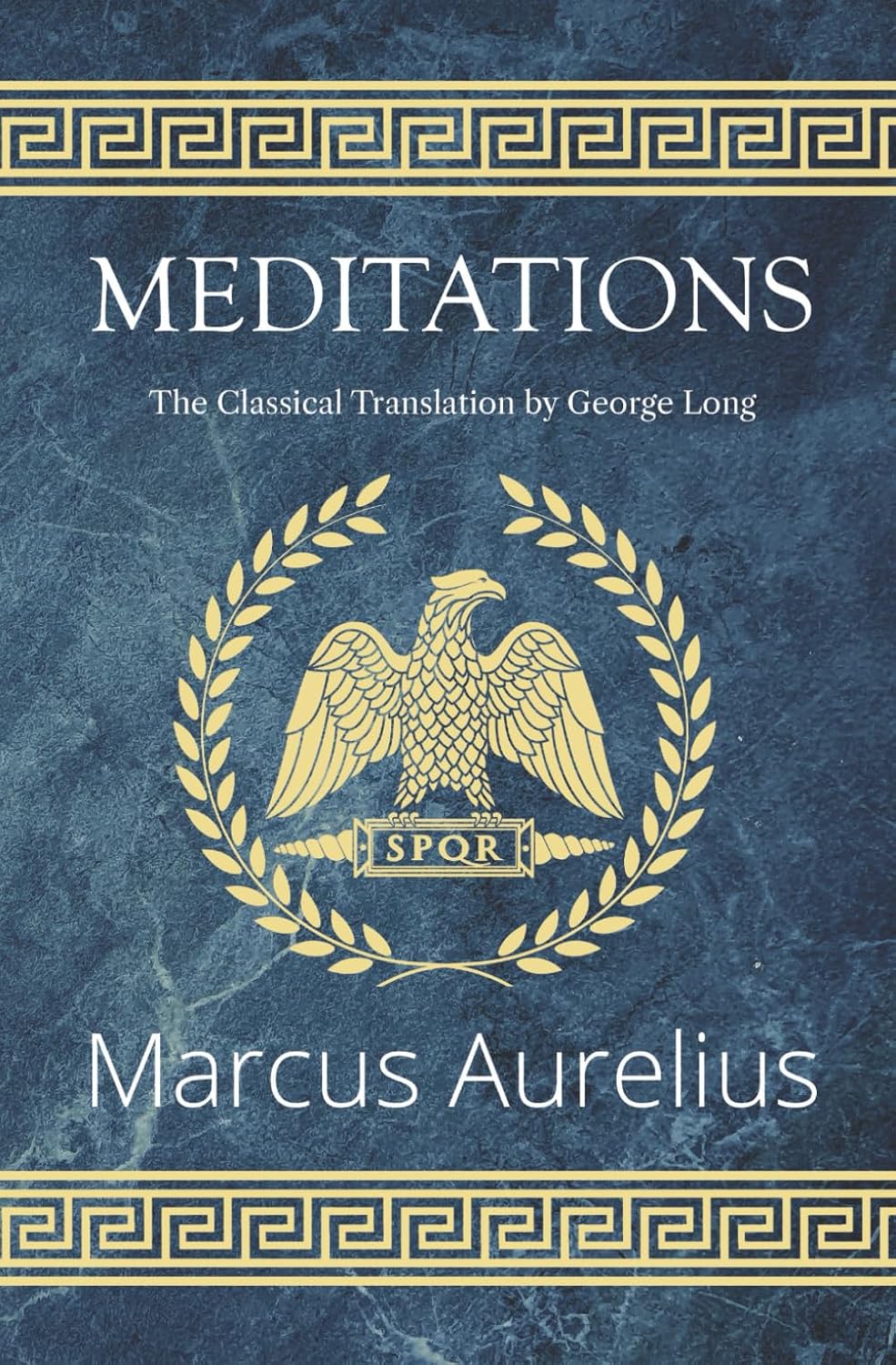
#5 — Meditations — trans. George Long (1862)
- Readability: Formal Victorian prose that can feel remote to modern ears.
- Accuracy: Good for its era; some Stoic terms now rendered differently by scholars.
- Tone: Weighty, formal, and grave, suited to the subject.
- Accessibility: Widely available free; useful for historical comparison.
About the Translators
Gregory Hays is a classicist and associate professor of classics at the University of Virginia. Hays came to Meditations as a scholar of late antique Latin literature and made a deliberate choice to render Marcus in unadorned, modern prose — a departure from the Victorian gravity of earlier translations.
Martin Hammond was Head Master of Tonbridge School and a translator of several major classical works for Penguin Classics, including Homer’s Iliad. His 2006 Meditations, published with an introduction by the classicist Diskin Clay, pairs clear modern prose with a fuller scholarly apparatus than Hays — explanatory notes plus a general index, an index of quotations, and an index of names.
Robin Waterfield is a British classical scholar who has produced acclaimed translations of Plato, Herodotus, Xenophon, Polybius, and Plutarch for Oxford World’s Classics and Basic Books. His 2021 Meditations is distinguished by its scholarly apparatus — substantial notes explaining the Stoic technical vocabulary Marcus is drawing on, particularly in relation to Epictetus. Waterfield’s approach is more literal than Hays’s, reflecting a preference for philosophical precision over stylistic elegance.
George Long (1800–1879) was a Victorian classicist who taught at the University of Virginia, then University College London, and later Brighton College. His 1862 translation was the standard English Meditations for nearly a century. Long translated in the tradition of Victorian scholarship: formal, weighty, and precise. His rendering of key Stoic terms reflects philological priorities that modern scholars have since revised.
Charles Reginald Haines (this site’s own edition) produced his translation for the Loeb Classical Library in 1916, with the Greek text printed alongside. Like Long’s, Haines’s English keeps older forms such as “thou” and “hath,” and his scholarly footnotes — often terse citations rather than explanations — are exactly what this site’s own modern annotation layer was built to unpack.
Themes
The central argument of Meditations is that the only things within our control are our own judgments and responses — not events, not the behavior of others, not death. Marcus returns to this position across all twelve books, often in nearly the same words, as a practice he keeps renewing rather than a doctrine set out once. See the Book-by-Book Synopsis for how the emphasis shifts from book to book.
The intellectual context is Stoicism as Marcus received it from Epictetus, a former slave who taught that external circumstances are neither good nor bad in themselves; only our response to them can be. Much of the book was written during the Marcomannic Wars on the Danube frontier (see The World of Marcus Aurelius), in a reign that also saw plague, a revolt in the East, and the deaths of several of Marcus’s children. The philosopher Pierre Hadot argued in Philosophy as a Way of Life (1995) that Meditations is best understood not as a philosophical treatise but as a collection of spiritual exercises — philosophy practiced rather than argued.
A recurring theme is how to carry out a role one did not choose. Marcus was adopted as heir at Hadrian’s direction and trained for rule, and he repeatedly tells himself to do his work without complaint and without regard for praise or blame.
Key Figures
Marcus Aurelius — Roman Emperor from 161 to 180 CE, the last of the Five Good Emperors, and in Meditations entirely a private person: a man holding himself to account. He addresses himself throughout in the second person (“you”), in exhortations, reminders, and self-recriminations. The public emperor is almost absent from the text; the private struggle is everything. He died in 180 CE during a campaign on the Danube, and the notebook was never prepared for publication.
Epictetus — The Stoic teacher whose influence pervades almost every page of Meditations, though Marcus rarely names him directly. A former slave who taught Stoic philosophy in Nicopolis in the late first and early second century CE, Epictetus articulated the distinction between what is “up to us” and what is not — the central principle on which Marcus’s notebook is built. His Discourses, recorded by the student Arrian, are the essential companion text to Meditations.
The Book I figures — In the first book, Marcus catalogs the teachers and family members who shaped him, naming what each gave him: from his grandfather, gentleness and serenity of temper; from Rusticus, the habit of reading attentively and not being satisfied with a superficial understanding; from Sextus, the example of a man of gravity who was also kind. The later books name many more people, chiefly historical figures and philosophers cited as examples, alongside unnamed types — courtiers, flatterers, the ungrateful, the dying — used as illustration rather than character. See the full Names in the Text for who each of them was.
Recommended Sources
Classical Quarterly — Founded in 1907 and now published by Cambridge University Press, one of the leading peer-reviewed journals for classical scholarship in the English-speaking world. It regularly publishes work on Marcus Aurelius, Stoic philosophy, and translation from the Greek philosophical tradition. Back issues are available through JSTOR.
Bryn Mawr Classical Review (bmcr.brynmawr.edu) — An open-access, peer-reviewed journal of reviews of new scholarship in classical studies. A reliable index of current academic opinion on translations and editions of ancient texts, including new editions of Meditations as they appear. Free to access.
A Companion to Marcus Aurelius (ed. Marcel van Ackeren, Wiley-Blackwell, 2012) — A collected volume of essays by specialists covering Marcus’s philosophy, his reign, the Greek text of Meditations, and its reception from antiquity to the present.
Frequently Asked Questions
What is Meditations about?
Meditations is a series of personal writings by Marcus Aurelius, Roman Emperor, reflecting on Stoic philosophy and how to live a virtuous life. It is a collection of spiritual exercises and personal reflections, emphasizing self-improvement, duty, and the transience of life.
Is Meditations hard to read?
Meditations can be challenging due to its philosophical content and historical context. The Hays translation is the most accessible, offering modern prose, while Waterfield provides a more literal and scholarly approach.
Which Meditations translation is best?
Each of the four translations compared here suits a different purpose. Hays’s is in plain modern prose; Hammond’s adds explanatory notes and three indexes; Waterfield’s is more literal, with extensive notes on Stoic philosophy; Long’s is a free public-domain Victorian version.
Hays vs Waterfield — which should I choose?
Hays suits a direct, conversational first encounter with the text. Waterfield suits readers already familiar with Hays who want a more literal, scholarly version with extensive notes on Stoic philosophy.
Which translation is easiest to read?
Gregory Hays’s Modern Library translation is the easiest to read. It renders Marcus in unadorned, modern prose that feels like a private journal rather than a historical document.
Which translation is most accurate?
Robin Waterfield’s 2021 translation is the most accurate for serious study. It is more literal than Hays and includes substantial notes on the Stoic technical vocabulary Marcus draws on.
What is the Martin Hammond Penguin Classics translation like?
Hammond’s 2006 Penguin Classics translation sits between Hays and Waterfield: readable prose with a substantial scholarly apparatus, including explanatory notes and a general index, an index of quotations, and an index of names — the fullest reference apparatus of any modern edition.
Should I read a free public-domain translation instead?
Both Long’s 1862 version and Haines’s 1916 translation are available free, and Haines’s is annotated here, online and as a free PDF. For a first encounter, however, a modern translation such as Hays offers easier entry.
Last reviewed: September 2026.
The full annotated Haines translation is available free; the Book-by-Book Synopsis provides an overview for readers seeking orientation first.